
Our solutions use an array of the latest material handling equipment and material handling automation technologies to automate your warehouse, maximizing throughput and streamlining operations across your entire supply chain. Our experienced material handling engineers draw on decades of expertise to recommend the right technology solutions for your operation – whether you integrate a single piece of equipment or engineer a complete automated material handling systems overhaul – and then ensure seamless integration with your existing storage systems, legacy warehouse management platforms, and floor-level conveyor systems.
This page is your guide to types of material handling equipment available to transform a standard warehouse or distribution center into a high-output, high-density facility. Browse the technology categories below or speak to a PWD engineer to begin your integration assessment.
Material handling is the discipline governing how raw materials and products are moved, stored, controlled, and protected throughout a manufacturing, warehousing, or distribution center operation. It spans everything from the moment a pallet arrives at the receiving dock to the final step of loading outbound trailers. Effective material handling requires the right material handling equipment for each stage of the material handling process – selecting the right material for the job prevents premature equipment failure, workplace accidents, and costly bottlenecks.
Poor material handling practices are one of the leading causes of workplace accidents, product damage, and unnecessary manual labour waste. Conversely, a well-engineered material handling setup – powered by appropriate ergonomic equipment, automated guided vehicles, and intelligent storage systems – can move large quantities of goods with fewer workers, fewer errors, and lower injury rates. Whether you are managing a compact warehouse or a multi-acre distribution center, the principles of safe, efficient materials handling remain the same: select the right material handling equipment for your load type and workflow, integrate it with your existing processes, and maintain it according to a preventive maintenance schedule.
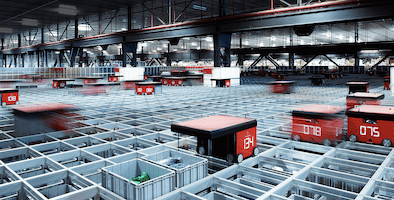
Automated storage and retrieval systems (AS/RS) offer significant advantages for warehouses and distribution centers. These systems use robot and crane-based pallet rack technology to deliver inventory via bins, trays, or pallet loads directly to operators. By eliminating the need for a forklift to enter every aisle, AS/RS maximize vertical storage space, minimize manual labour, and accelerate the retrieval and storage of bulk materials – leading to measurable throughput gains and fewer workplace accidents. PWD engineers work with all major AS/RS load families, from mini-load systems handling small parts to unit-load cranes built for pallet-scale bulk materials.
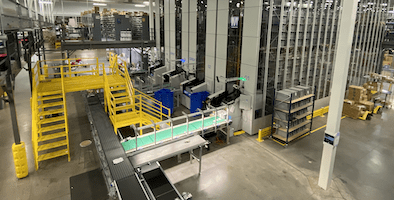
Goods-to-person solutions utilize automated storage and retrieval systems to boost picking efficiency by bringing items directly to workers or ergonomic workstations. This technology eliminates the need for manual searching, significantly speeds up the order fulfillment process, reduces walking, and improves overall picking accuracy. By shortening travel distances and eliminating unnecessary movement, goods-to-person systems help warehouse employees fulfill more orders per shift while reducing costs associated with mispicks and returns.
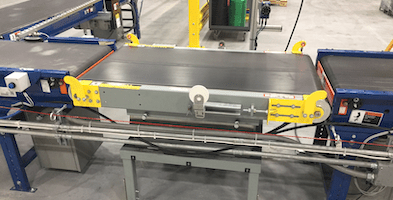
In-motion weighing, or check-weighing, systems provide real-time weight data as items move along a conveyor system. This enables immediate verification of weights, streamlines inventory management, reduces manual weighing steps, and improves the speed and accuracy of shipping and receiving processes. For high-volume distribution center operations processing large quantities of outbound freight, in-motion weighing is a critical piece of the material handling automation stack – catching weight discrepancies before they become costly carrier claims.

Pick-to-Light and Put-to-Light systems use illuminated displays to guide workers to the correct items and quantities for picking or putting away. This visual direction increases speed, reduces errors, and improves the overall efficiency and accuracy of warehouse fulfillment tasks. When paired with a goods-to-person workstation, pick-to-light creates one of the fastest split-case picking workflows available in material handling equipment today – ideal for e-commerce and retail operations where order accuracy directly impacts customer satisfaction scores.

These systems automatically print and apply labels to items or packages as they move along a production line or conveyor system. This automation increases labeling speed and accuracy, reduces manual labor, and ensures consistent and legible labeling for efficient tracking and shipping. A properly configured Print & Apply station eliminates the packaging materials bottleneck that forms before the loading dock, keeping outbound lanes clear and reducing trailer dwell times.

Robotics, including automated guided vehicles (AGVs) and autonomous mobile robots (AMRs), automate the transportation of goods within a warehouse. These systems improve efficiency, reduce labor costs associated with manual transport (forklift, pallet jacks, industrial trucks), enhance safety by handling repetitive tasks, and offer flexible solutions for transporting goods across dynamic facility layouts. Unlike fixed conveyor systems, AGVs and AMRs can be reprogrammed to respond to changing workflows, making them one of the most versatile additions to any material handling operation – from a single mezzanine level to a multi-acre distribution center.

Scanning technology enables rapid and accurate identification of items within manufacturing or warehouse operations. It speeds up receiving, put-away, picking, and shipping processes, improves inventory accuracy, reduces data entry errors, and enhances overall supply chain visibility. Whether leveraging barcode, RFID, or vision-based identification, modern scanning solutions are the connective tissue between your warehouse management system and the physical movement of goods – the data layer that makes real-time operations possible across your entire logistics infrastructure.

Warehouse software and control systems provide real-time visibility and management of warehouse operations. They optimize storage, picking, and shipping processes, improve inventory accuracy, streamline workflows, and enable data-driven decision-making for enhanced efficiency and productivity. Furthermore, software systems provide remote access and improve maintenance support of automated systems – reducing unplanned downtime and extending the service life of your material handling equipment.

VLM (Vertical Lift Modules) and carousels maximize vertical space, presenting stored items directly to the ergonomic operator workstation. This saves floor storage space, improves picking speed and accuracy, enhances security, and creates a more ergonomic picking environment compared to traditional pallet rack shelving. VLMs are particularly effective for managing small parts, tools, and high-value materials and products – reducing the number of items exposed to manual labour handling and minimizing the risk of product damage in the warehouse environment.
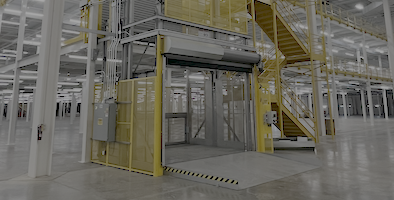
Vertical Reciprocating Conveyors (VRCs) efficiently and safely allow goods to be moved between different levels in a warehouse or distribution center, eliminating manual lifting, speeding up the transfer of materials between floors, and optimizing the use of vertical space for smoother operations. VRCs are a critical piece of material handling equipment for facilities utilizing a mezzanine level or multi-floor distribution center layouts – replacing the slow and hazardous practice of using a forklift to raise and lower pallet loads between levels.
Selecting the right material handling equipment for your facility requires matching the physical characteristics of your goods to the capabilities of the technology. Start by answering these four questions:
What are your load types and unit sizes? A facility built around pallet-scale bulk materials will have fundamentally different material handling equipment needs than a micro-fulfillment center running 2-gram items in totes. Understanding whether your operation moves unit loads, cases, totes, or each-of (eaches) determines whether you need a crane-based AS/RS, a pallet shuttle, or pick-to-light workstations.
How much vertical storage space is available? Many facilities overlook their available vertical clearance. A VLM or vertical carousel can turn wasted headspace into high-density storage, while a VRC enables safe transport of pallet loads between mezzanine levels without forklift risk. Before adding floor-level conveyor systems, audit your vertical footprint – it is almost always the most underutilized dimension in a warehouse.
What is your throughput target? High-speed ecommerce fulfillment demands different material handling technology than a wholesale distribution center moving full-case bulk materials on pallet racking. Throughput-driven facilities benefit from goods-to-person robotics, high-speed sorters, and automated conveyor systems – while lower-velocity operations may achieve ROI through simpler ergonomic equipment and improved storage layouts.
Do you need to integrate with an existing warehouse management system? Modern material handling automation is only as valuable as its visibility layer. Whether you run a legacy inventory platform or a modern cloud-based warehouse management solution, ensure the equipment you select can communicate via standard APIs. PWD engineers build this integration layer into every project from discovery – because real-time data synchronization is non-negotiable for efficient material handling at scale.
Investing in modern material handling technology delivers compounding returns across your entire operation. Here is what facilities experience after a PWD-engineered material handling automation deployment:
Labor cost reduction: Automating the movement of pallet loads with automated guided vehicles, eliminating manual put-away with AS/RS, and speeding up picking with pick-to-light drastically reduces the manual labour hours required per order. For a mid-size distribution center, this can translate to hundreds of thousands of dollars in annual labor savings.
Space reclamation: High-density pallet rack systems, VLMs, and crane-based AS/RS can increase storage capacity by 40–70% within the same building footprint by utilizing vertical storage space that traditional pallet jacks and forklift aisle requirements leave dormant. Reclaiming this space often delays or eliminates the need for facility expansion.
Throughput improvement: A fully integrated set of automated material handling systems can accelerate the order fulfillment process by 2–5x compared to manual operations. Faster throughput means lower per-unit handling cost, shorter carrier delivery windows, and the capacity to handle seasonal volume spikes without adding temporary labor.
Workplace safety improvement: The Occupational Safety and Health Administration (OSHA) consistently ranks forklift-related incidents and manual lifting injuries among the top causes of serious workplace accidents in warehousing. Replacing forklift, pallet jack, and hand truck operations with ergonomic equipment like VLMs, carousels, and AMRs shifts the most dangerous transport tasks to automated systems – protecting workers and reducing insurance costs.
Reduced product damage: Items handled by industrial trucks, forklift, and manual means suffer higher rates of transit damage. Automated storage systems and AMRs move goods with precision, reducing the impact events that cause product loss – particularly important for high-value materials and temperature-sensitive goods.
We engineer and integrate the full spectrum of warehouse automation equipment – including automated storage and retrieval systems, conveyor systems, AGVs and AMRs, pick-to-light workstations, VLMs, and VRCs. Our integration services cover the equipment itself, the warehouse management software layer, and the preventive maintenance program that keeps your operation running at peak performance.
Yes. PWD regularly works within established pallet rack and forklift environments, adding automation layers that complement rather than replace existing infrastructure. For example, a pallet shuttle can be retrofitted into existing drive-in or push-back racking systems, and AMRs can safely share aisle space with regulated industrial trucks under a coordinated control system.
A targeted single-technology installation (such as a pick-to-light deployment or a standalone AS/RS cell) can be designed and commissioned in 3 to 6 months. Larger multi-technology projects spanning multiple process areas across a distribution center may take 12 to 18 months from initial engineering to full operational handover. PWD’s agile project management approach ensures partial sections go live as soon as they are commissioned – many facilities begin realizing ROI before the full project is complete.
Automation elevates rather than eliminates the warehouse employee role. By automating the heavy lifting, repetitive transport, and high-risk tasks typically assigned to a forklift operator or pallet jack handler, your workforce is reallocated to supervisory, quality control, and system management roles that are higher-value and less physically demanding. This shift also supports better job satisfaction scores and lower turnover – a significant hidden cost saver in labor-intensive logistics operations.
Every system PWD commissions includes a preventive maintenance schedule calibrated to the equipment manufacturer’s specifications and your facility’s operating hours. Automated guided vehicles require software updates and battery service cycles. AS/RS cranes need periodic mechanical inspection. Conveyor systems benefit from belt tensioning and roller cleaning regimes. We build this maintenance schedule into your handover documentation and can provide ongoing technician support as a managed service.
Contact Precision Warehouse Design today for a consultation. Discover how our tailored material handling solutions can drive efficient material handling, reduce costs, and accelerate growth across your supply chain.
👉 Schedule a Material Handling Consultation
Looking for process-focused solutions instead? Browse our Solutions by Function page to explore how PWD optimizes receiving, picking, packing, and returns – from the ground floor up.