Warehouse engineering isn’t about guessing. It’s about data. When you get the math wrong on a warehouse layout, storage medium, or automation system, you pay for it in missed SLAs, bloated labor costs, and operational bottlenecks that hurt your entire supply chain. So many companies suffer from lost revenue due to these issues.
At Precision Warehouse Design (PWD), we are vendor-neutral integrators. We look strictly at your throughput volume, order profiles, and facility data to design fulfillment engines that work. Based on our experience stepping in to rescue stalled projects and fix inefficient layouts, here are the most common warehousing mistakes we see in the field, and the exact technology and processes required to fix them to improve your warehouse performance. Avoid these common warehousing mistakes to ensure future growth for your business.
1. Operating a “Flat” Warehouse: An Inefficient Use of Warehouse Space (Wasting Vertical Space)
Running out of floor space doesn’t mean you are out of room. Expanding your physical footprint or leasing a secondary facility requires heavy capital expenditure. If you aren’t utilizing the clear height of your building to maximize space utilization, you are leaving money on the table and creating wasted space.
The Engineering Fix: A data-driven Warehouse Racking Design strategy reclaims that lost square footage. By engineering custom structural Mezzanines, you can effectively double (or more) your usable warehouse space for storage or active picking. To move pallets or heavy loads between levels safely without relying solely on forklift traffic, we integrate a VRC (Vertical Reciprocating Conveyor). Implementing proper safety protocols around this equipment prevents serious injury to employees and workers.
2. Sizing Sortation Systems for Average Volume, Not Future Growth or Peak
Designing routing systems based on average daily volume is a critical error in supply chain management. When peak season hits, undersized systems become immediate bottlenecks. Cartons back up on the recirculation lines, active picking zones gridlock, and your outbound process stops, negatively impacting customer satisfaction.
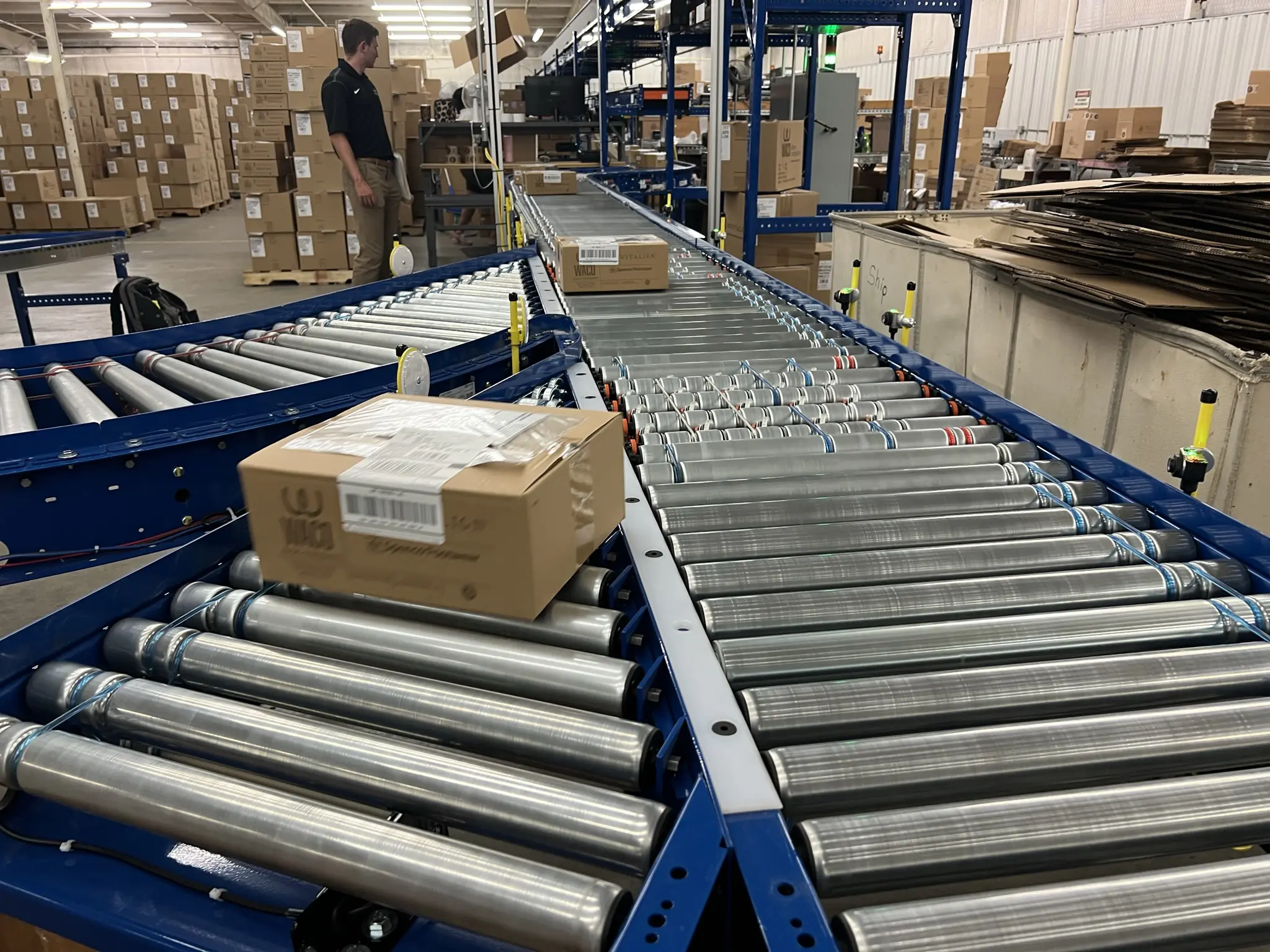
The Engineering Fix: Your Conveyor & Sortation Systems must be engineered for peak throughput and future growth. We analyze your specific customer orders and order profiles to ensure order fulfillment routing keeps cartons moving smoothly from picking zones straight to the Packing & Shipping lanes during periods of seasonal spikes and growth, eliminating upstream jams and inefficient processes. Measuring performance of these processes helps identify trends and improve operational efficiency.
3. Mismatching Storage Technology to SKU Velocity and Excess Inventory
Treating every SKU the same wastes space and throttles velocity, often leading to excess inventory. Storing slow-moving parts in standard pallet rack increases picker travel time and creates bottlenecks. Conversely, forcing bulky, fast-moving cases into a complex robotic system wastes CapEx and slows down throughput.
The Engineering Fix: Match the technology to your inventory data. Proper inventory management is key. For predictable, fast-moving items, traditional flow-driven Pick Modules offer cost-effective, high-velocity throughput and efficient picking paths. For high SKU proliferation of medium-to-slow movers, ultra-dense VLM & Carousel Storage or Automated Storage & retrieval systems (AS/RS) maximize footprint efficiency. Bulk items should remain in optimized Pallet Handling and standard Storage setups, which helps manage excess inventory properly and maintain inventory accuracy.
4. Throwing Headcount at a Travel Time Problem (Ignoring Employee Training and Staff Development)
In legacy operations, the default answer to volume spikes was hiring more people. With today’s labor shortages and high turnover rates, paying operators to walk up and down aisles, which often consumes 30 – 60% of a shift is no longer a viable business model for an efficient warehouse. Mistakes happen when employees lack support, don’t have proper training (or experience), and are not provided with the proper equipment to perform their job.
The Engineering Fix: Stop paying for walk time to save money and increase efficiency. Invest in Goods-to-Person automation or autonomous Robotics – AGV/AMR fleets to deliver inventory directly to stationary operators. If full robotics doesn’t fit the ROI model, deploying Pick-to-Light / Put to Light hardware alongside mobile Scanning Technology, or equipment on demand (RaaS) drastically accelerates manual Picking, allowing you to decouple throughput from headcount. Good employee training, staff training, and staff development are essential here to ensure picking accuracy and proper picking order fulfillment, reducing human error and improving employee morale.
5. Building “Islands of Automation” vs. Integrated Warehouse Management Systems
Buying high-end mechanical hardware without a plan for how it communicates with your warehouse management systems or ERP creates disconnected islands of automation. If your systems can’t talk to each other, you end up relying on manual workarounds to bridge the gaps, defeating the purpose of the investment and causing inventory errors.
The Engineering Fix: Hardware is only as effective as the software driving it. True efficiency requires expert Systems Integration. We focus heavily on Software & Controls architecture to ensure disparate technologies function as one unified engine for your entire operation. With in-house Controls & Panel Build capabilities, we don’t just supply equipment; we write the logic that runs it. Implementing modern data collection and reporting tools ensures your warehouse operations run smoothly.
6. Ignoring the Receiving and Outbound Docks (Leading to Inventory Inaccuracies)
Warehouse operations often obsess over the picking process while neglecting how goods enter and exit the building. A bottlenecked receiving dock guarantees inventory inaccuracies downstream, while manual shipping processes cause carrier delays and result in shipping the wrong items.
The Engineering Fix: Your Receiving operations must be structured for rapid intake and stocking methods to make inventory available for picking immediately, optimizing your supply chain. On the outbound side, integrating In-Motion Weighing and automated Print & Apply Systems processes shipments at high speeds with zero manual touches using high quality labels. Regular cycle counting and barcode scanning can further prevent inventory errors. Additionally, setting up a dedicated lane for Returns processing is critical for modern Ecommerce Fulfillment, ensuring returned goods quickly re-enter active stock.
7. Underestimating Permitting, Safety Protocols, and Installation
Attempting to manage a major facility upgrade internally is a massive risk for many warehouses. Overlooking local fire codes, safety risks, seismic requirements, or city permits can halt a project for months. Poorly phased installations disrupt daily operations and kill profitability for many facilities.
The Engineering Fix: Work with an integrator that owns the entire lifecycle to guarantee efficient operations. PWD’s Consulting & Design team ensures the initial math works before you spend a dime. We navigate local municipalities through our in-house Permitting Services, and our Installation Services team phases the build-out to minimize operational downtime. If you are moving facilities entirely, our Warehouse Relocation services manage the transition from teardown to startup, protecting your business and employees by maintaining strict safety protocols.
Stop Guessing. Start Engineering with PWD
Warehouse mistakes in warehouse layout carry heavy financial consequences. At Precision Warehouse Design, we engineer out the guesswork for warehouse managers so you can achieve an efficient warehouse. Contact our team today to schedule a data-driven assessment of your facility to elevate your performance and supply chain management.