Modern warehouses are more complex than ever. Order volumes are rising. Customer expectations are growing. To stay competitive, operations need reliable systems that manage both planning and real-time execution. That is why understanding the differences between WMS, WES, and WCS software systems is essential. Each plays a different role. Each supports a different part of your warehouse. When used together, they help you get more value from your automation investments.
The Digital Brain and Nerves of Today’s Warehouse
You deal with constant changes in order demand. You handle thousands of SKUs. A Warehouse Management System (WMS) and Warehouse Control System (WCS) work together to make fast, accurate fulfillment possible in the busiest warehouse.
Think of the WMS as the strategic brain. It plans work, manages inventory, communicates with ERP, and coordinates people. The WCS acts like the nervous system. It directs equipment and controls the real-time flow of goods. Understanding how they differ helps you select the right tools for your operation.
What Is a Warehouse Management System (WMS)? The Strategic Planner
A WMS looks ahead. It manages work across minutes, hours, and days. It focuses on accuracy and organization. A full WMS typically handles:
- Inventory control down to bin, pallet, or slot level
- Cycle counting and reconciliation
- Order waving and release rules based on priority, carrier cutoff, or labor availability
- Slotting guidance to improve pick speed
- Pick-path optimization for manual and RF picking
- Labor management, including task assignments and productivity tracking
- Yard and dock scheduling for inbound and outbound shipments
- Packing, manifesting, labeling, and shipping documentation
- Communication with finance system(s) like ERP
Your WMS acts as the central plan for the warehouse. It tells people and automation what work needs to be done, when to do it, and what resources to use.
What Is a Warehouse Control System (WCS)? The On-the-Floor Director
A WCS works in real time. It manages the movement of products through automated systems. It thinks in seconds and milliseconds. A complete WCS typically includes:
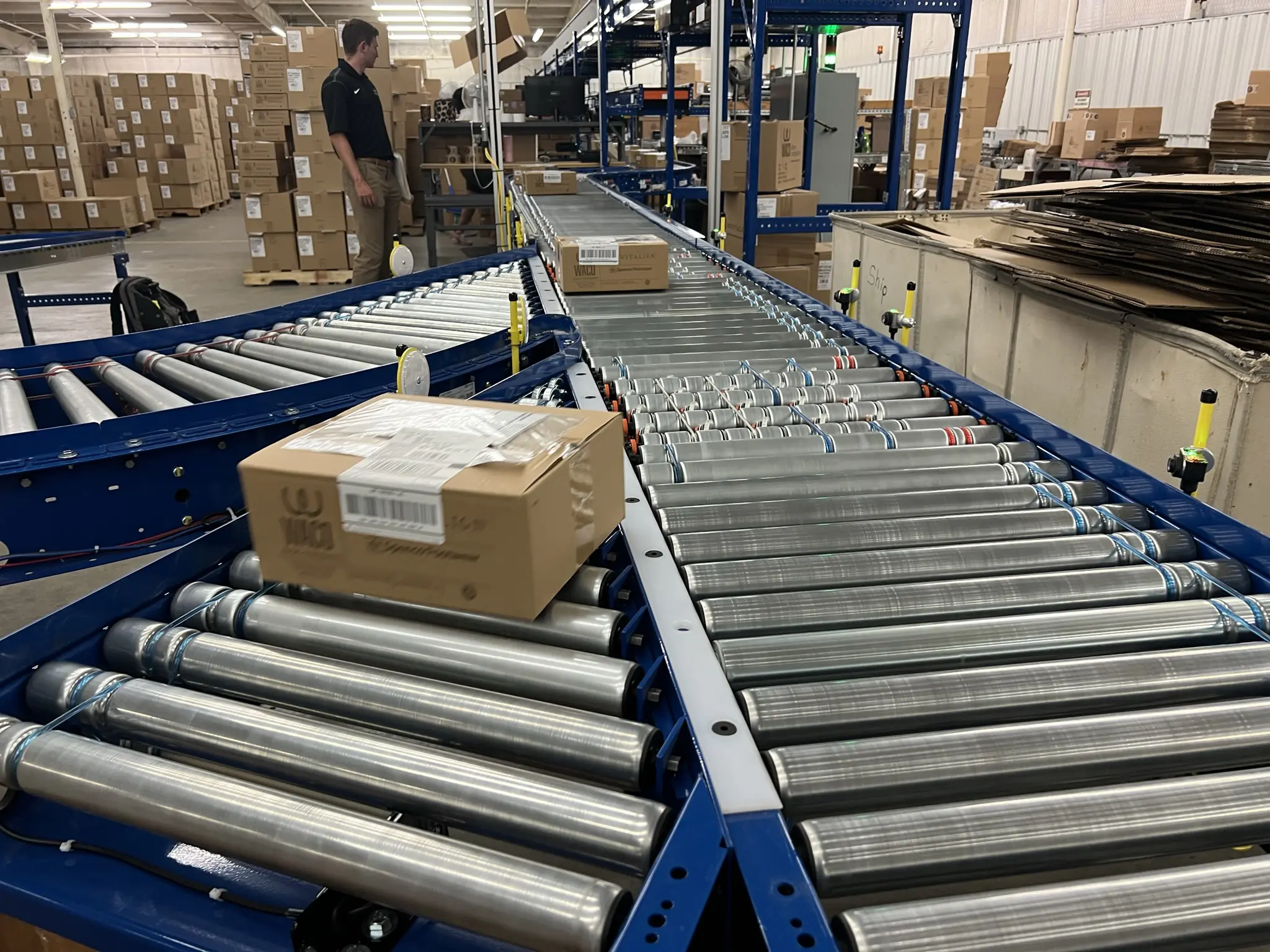
- Real-time equipment control for conveyors, merges, diverts, and sorters
- AS/RS command handling for storage and retrieval
- Carton or tote routing logic based on order needs or lane capacity
- Buffer management to prevent backups and maximize throughput
- Error handling and exception recovery when sensors or equipment fail
- Direct communication with PLCs for instant status updates
- Load balancing across induction points, pack stations, or shipping lanes
- SCADA and/or HMI ability
The WCS ensures that the plan built by the WMS is executed without interruption. It keeps products moving smoothly and reacts instantly to equipment signals..
Key Differences: WCS vs WMS Head-to-Head
Decision-Making and Timescale
A WMS plans work in batches. It decides which orders should be released and how work should be sequenced. A WCS makes immediate decisions. It diverts cartons, adjusts routing, and prevents jams.
Data and Integration
A WMS connects with your ERP or order management system. A WCS connects with PLCs on conveyors, sorters, and other machinery. These systems must work together. A skilled integrator like Precision Warehouse Design helps create the data bridge so every part of your warehouse functions smoothly.
The Next Evolution: WES vs WCS
The rise of automation has created demand for a system that sits between the WMS and WCS. This is where the Warehouse Execution System (WES) comes in.
A WES blends real-time decisions with mid-level planning. A strong WES platform often includes:
- Work release based on system capacity instead of fixed waves
- Dynamic prioritization of tasks as orders change throughout the day
- Dashboards for equipment performance and order tracking
- Task orchestration across AMRs, AS/RS systems, goods-to-person solutions, and manual areas
- Pick-to-light or put-to-light control
- Intelligent batching that groups orders to speed up picking
WES vs WCS: Is It a Replacement?
A WES is not always a replacement for a WCS. High-speed automation still needs a dedicated WCS for sub-second control. But a WES is ideal for coordinating several types of automation, such as goods-to-person systems or AMRs.
Building Your System: How an Integrator Brings It All Together
Software does not work in isolation. The physical layout, equipment, and software must all support each other. Precision Warehouse Design understands both the material handling equipment and the system design. Our team helps select and implement the right combination of WMS, WCS, and WES for your goals.
Our FasTrak design service helps define system requirements for today’s fast-moving operations. It creates a clear plan so your technology stack performs the way you need.
FAQs about Warehouse Control Solutions
What is a WCS?
A WCS is Warehouse Control System software that manages and directs real-time product movement on automated equipment, keeping goods flowing smoothly through conveyors, sorters, and other material handling systems.
What is warehouse control system software?
Warehouse control system software manages real-time product movement on automated equipment. It directs conveyors, sorters, and storage systems so goods flow smoothly through the warehouse.
How does a warehouse control system support daily operations?
A warehouse control system keeps equipment running efficiently by making instant routing decisions, preventing backups, and ensuring every tote or carton reaches the correct destination.
What role does WCS play in the supply chain?
WCS supply chain functionality focuses on fast, accurate product movement inside the warehouse. It improves throughput, reduces delays, and helps facilities meet tight shipping windows.
What are warehouse control solutions?
Warehouse control solutions include the software, controls, and integrations that manage automated systems. These solutions keep equipment synchronized and maintain continuous product flow.
Why do automated warehouses need warehouse control system software?
Automated warehouses rely on warehouse control system software to make split-second decisions that a WMS cannot. It ensures equipment runs safely, efficiently, and at maximum throughput.
How is a warehouse control system different from a WMS?
A warehouse control system manages real-time execution, while a WMS handles planning and inventory. The WCS controls equipment; the WMS manages orders and data.
Ready to Optimize Your Operations? Let’s Build Your Warehouse Solution with PWD
Each warehouse has different needs:
- If your processes are manual or RF-based, you need a WMS.
- If you add conveyors or high-speed automation, you need a WCS.
- If you combine several automation technologies, a WES may be the best fit.
Choosing the right system depends on your workflow and your growth plans. Partnering with an experienced integrator is the first step to designing a system that delivers results.Precision Warehouse Design works with automated facilities every day, ensuring each system is selected and integrated to keep operations running at a high level. Reach out to us to design the right solution for your warehouse.