Many warehouses hit space constraints faster than expected. Storage costs keep climbing and lease rates rise, while construction timelines stretch out. The common response is to move or expand. That choice feels simple, but it is often the most expensive option.
In many facilities, unused capacity is hiding in plain sight. Empty vertical space. Wide aisles sized for the wrong equipment. Slow-moving inventory sitting in prime locations. Smarter warehouse space management can unlock that capacity before you add square footage.
At Precision Warehouse Design, we help operations maximize warehouse space through engineered racking, mezzanines, and automation. Our focus is to help you use what you already have more effectively before you commit to a move.
Warehouse Space Management Fundamentals
Before changing layouts or buying equipment, start with a structured evaluation. The right improvements come from facts, not assumptions.
How to Audit Warehouse Space Effectively
A warehouse audit is the foundation of smart space management. It shows you how space is actually being used and where capacity is hiding.
Begin with a detailed walk-through. Document SKU locations and storage types. Map travel paths for pickers and lift trucks. Note congestion points, double-handling, and long travel distances. Take photos and measurements.
This process highlights blocked rack levels, oversized aisles, and staging areas that have expanded beyond their limits. If proposed changes affect rack height, aisle widths, or fire protection systems, involve a professional warehouse design review.
Understand Your Current Warehouse Space Utilization
Once the audit data is collected, quantify your current versus potential capacity. Current capacity reflects how many pallet positions or storage locations are actively used. Potential capacity considers building clear height, rack engineering limits, and safe operating clearances.
Conduct a basic cube analysis. Compare the building’s total cubic volume to the cubic volume currently used for storage. Many facilities discover they are using far less vertical space than available.
This step converts audit findings into measurable opportunities.
Using Data to Guide How to Maximize Warehouse Space
Operational data should drive every layout decision. Review SKU velocity, order profiles, and seasonality trends.
Use ABC analysis to prioritize changes. A – items require the most accessible locations. B -items need balanced access. C – items can be stored higher or farther from primary pick paths.
These insights directly influence layout decisions.
Maximizing Vertical Space to Maximize Warehouse Capacity
Racking to the Roof: Core Strategy to Maximize Warehouse Space
Most warehouses do not store as high as they safely could. Compare current rack height to building clear height. Even adding one or two beam levels can dramatically increase pallet positions.
For example, raising rack height from 20 feet to 28 feet in a 32-foot clear building can add thousands of pallet locations without expanding the footprint.
Engineered pallet rack design matters here. Load calculations, seismic requirements, and permitting all come into play. Professional design and stamped drawings protect both people and inventory.
Choosing the Right Rack Types for Better Warehouse Space Utilization
No single rack type fits every operation. A selective pallet rack provides direct access to every pallet and maximum layout flexibility. Double-deep and push-back racks increase density with some selectivity trade-offs. Drive-in and pallet flow racks maximize density for uniform SKUs.
The right choice depends on SKU count, pallet consistency, and throughput needs. Solutions designed by Precision Warehouse Design align rack types with real operating data, not guesswork.
Safety, Load Limits, and Compliance When Increasing Storage Density
Higher density raises safety stakes. Rack capacity ratings, anchoring, and column protection are critical. Fire codes, sprinkler clearances, and egress lanes must be maintained in accordance with regulations, and professional engineering helps ensure compliance while avoiding costly retrofits later.
Professional engineering ensures compliance and avoids costly retrofits later.
Using Mezzanines to Maximize Warehouse Space Without Moving
When a Mezzanine Makes Sense for Warehouse Space Management
Mezzanines add a second level within your existing footprint. They work well when operations need more space for offices, kitting, light storage, or e‑commerce packing.
A common scenario is a growing fulfillment operation. The floor is packed with pallets, but packing stations and returns areas keep expanding. A mezzanine above part of the floor can solve the problem without relocation.
Common Mezzanine Use Cases to Improve Warehouse Space Utilization
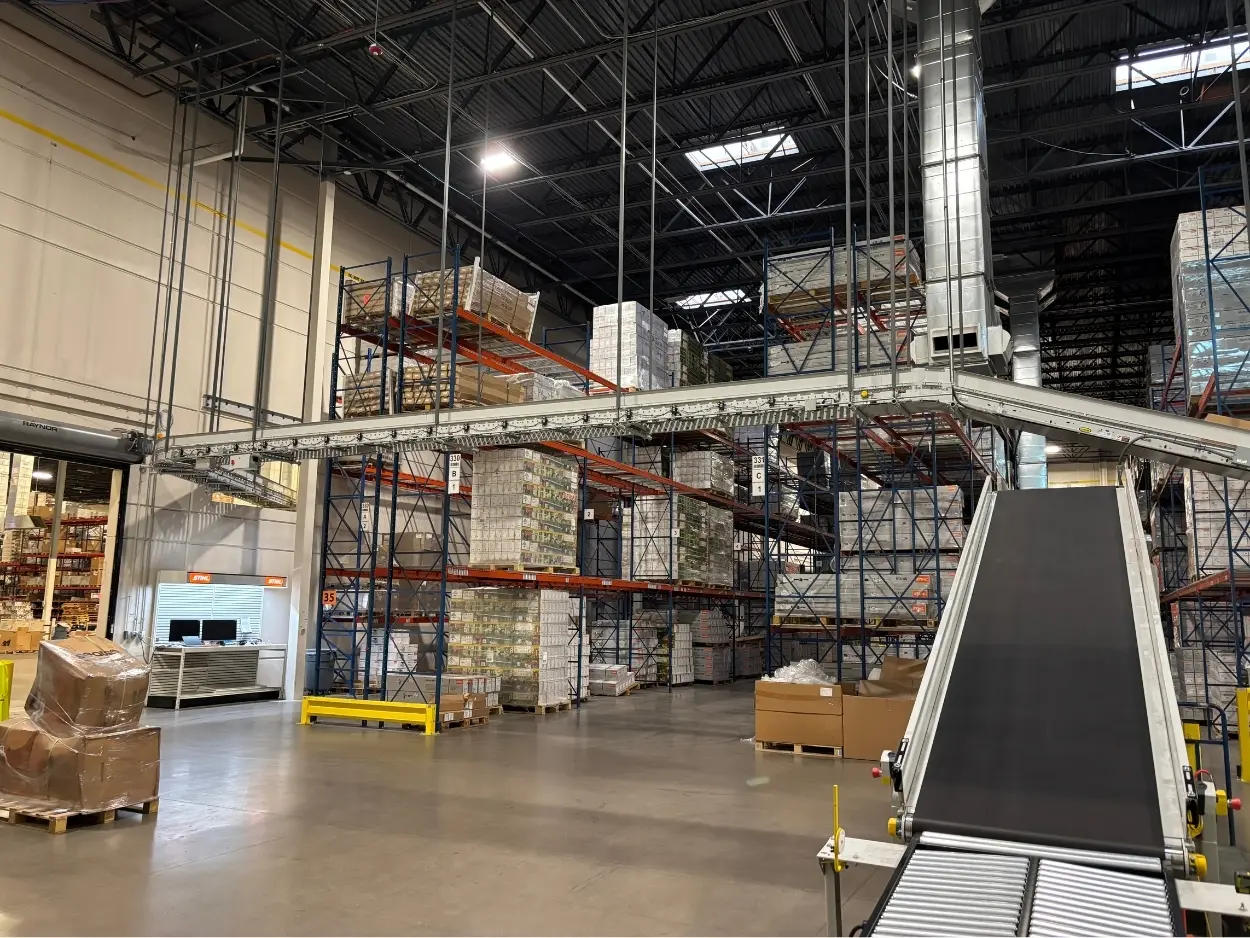
Mezzanines are often used to separate functions and free up pallet storage below. For example, small-parts shelving can be installed above active pallet rack rows, while packing, quality control, or returns processing operate on the new upper level. This keeps floor space focused on bulk storage and material handling.
In many designs, conveyors,chutes, or vertical reciprocating conveyors (VRCs) connect levels to maintain flow and reduce manual handling. Rather than replacing pallet racking, mezzanines are typically integrated into the existing layout to increase total usable square footage.
Structural vs. Modular Mezzanines: Impact on Space and ROI
Structural mezzanines support heavier loads and larger column-free spans because they are typically built from structural steel and designed for higher weight capacities. Modular systems use lighter, standardized components, install faster, and offer more flexibility for future changes or relocation.
Partnering with a qualified designer/installer ensures the mezzanine fits current needs and future growth, while simplifying communication, maintaining clear accountability, and reducing delays between design and construction.
Smarter Layouts for Better Warehouse Space Management
Sometimes, a simple layout adjustment can maximize warehouse space. The strategies below improve warehouse space utilization without expanding your footprint.
- Right-size your aisles. Match aisle widths to your material handling equipment. Many warehouses operate wide aisles for reach trucks when narrow or very narrow aisle systems would work. Converting even part of a layout to narrower aisles can free significant space, as long as safety and traffic flow remain a priority.
- Optimize pick paths. Place fast movers near shipping and packing to reduce travel time and congestion. Relocating top SKUs to a golden zone near dock doors often improves both space use and labor efficiency.
Slotting Strategies: Put Every SKU in Its Best Location
Slotting and Storage Media Strategies That Improve Density and Flow
These approaches help maximize warehouse space utilization and picking efficiency.
- Use velocity-based slotting. Group SKUs by movement. Place high-velocity items in easy-to-reach locations and push slow movers higher or farther back. This reduces congestion and supports higher storage density without hurting productivity.
- Right-size your storage media. Match storage types to SKU size and weight. Oversized pallet positions waste space. Carton flow, shelving, bins, and cantilever racks all have a role. Dividers and totes can eliminate air storage and increase usable capacity.
ASRS: Automated Storage and Retrieval Systems to Maximize Warehouse Space
Automation can play a major role in warehouse space management when traditional racking approaches reach their limits.
What Is ASRS and How It Transforms Warehouse Space Management
ASRS uses automated equipment to store and retrieve inventory in dense configurations. For example, a shuttle or mini-load system can store pallets or totes in high-bay structures with minimal aisle space, automatically delivering them to a pick station when needed. These systems excel at vertical utilization and consistency while reducing labor travel and improving order accuracy.
They often reduce aisle requirements and improve accuracy.
ASRS Types that Improve Warehouse Space Utilization
Common types include shuttle systems, unit-load ASRS, and mini-load systems. Vertical Lift Modules and vertical carousels work well for small parts and high-value items.
These systems fit e‑commerce, spare parts, and regulated environments.
When to Implement ASRS to Maximize Warehouse Space vs. Traditional Racking
ASRS makes sense when SKU counts are high, land costs are rising, or building height is limited. Many operations benefit from hybrid designs that combine rack and ASRS.
Operational Practices that Free Up and Maximize Warehouse Space
Daily operating discipline plays a major role in warehouse space management and long-term warehouse space utilization.
- Control inbound staging. Uncontrolled receiving can consume valuable space if it is not managed closely. Set clear time limits for staging, improve dock layout to support flow, and enforce pallet and carton standards with vendors to keep product moving.
- Protect inventory health. Regularly identify obsolete and slow-moving inventory and establish clear rules for liquidation or disposal. Stronger forecasting practices also help reduce excess safety stock and prevent unnecessary space consumption.
Schedule Your Warehouse Space Optimization Assessment Before You Consider Moving
Before you move or expand, take a strategic, data-driven approach that evaluates layout, storage systems, automation, and daily operations before committing to expansion.This approach often eliminates the need to relocate, helping you avoid the cost, disruption, and downtime that come with a facility move. Contact the Precision Warehouse Design team to schedule your warehouse space assessment and start maximizing your existing footprint today.