
OSHA fines for serious violations currently start at over $16,000 per citation. A single rack collapse can trigger workplace injuries, lost inventory, facility damage, regulatory scrutiny, and operational downtime—costs that dwarf the investment in a proactive safety inspection. For warehouse operators, a professional warehouse safety audit is one of the highest-ROI steps available to protect employees, reduce liability exposure, and demonstrate compliance with occupational safety standards.
Beyond regulatory fines, unaddressed hazards carry hidden costs: increased workers’ compensation claims, higher insurance premiums, lost productivity during incident investigations, and the reputational impact of a recordable workplace injury. A documented warehouse safety audit creates an audit trail that demonstrates due diligence and supports your defense in the event of an OSHA investigation.

OSHA 1910.22 requires employers to maintain walking-working surfaces in safe condition. The Rack Manufacturers Institute (RMI) recommends a formal professional racking inspection at least annually, in addition to regular internal monitoring.
Our warehouse safety assessments are structured to evaluate every major risk category in a storage and distribution environment. Each audit includes a visual warehouse inspection, a comprehensive checklist-based evaluation, and a structural assessment of your racking systems. Below are the core areas covered.
Rack damage is one of the most common and consequential hazards in warehouse environments—and one of the most frequently overlooked during informal walk-throughs. We conduct a detailed inspection of all racking system configurations, including selective pallet rack, cantilever rack, drive-in, push-back, and pallet flow systems. Each racking inspection evaluates:
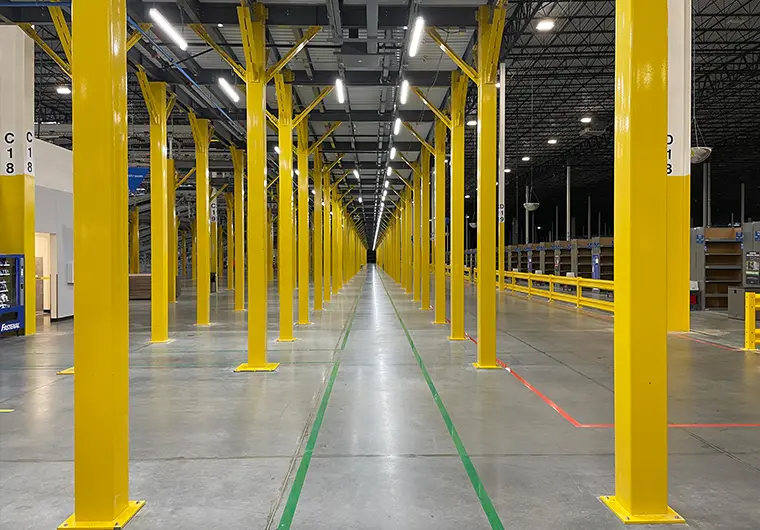
Undersized aisles are a leading cause of both rack damage and forklift accidents. Our warehouse inspectors measure aisle widths against applicable OSHA standards and cross-reference your specific material handling equipment requirements. We identify areas where forklift clearance is inadequate and flag traffic patterns that create conflict zones between pedestrians and forklift operators.
We verify that all emergency exit routes are unobstructed, clearly marked with directional signage, and fully compliant with OSHA 1910.36 and applicable local fire codes. This includes checking for blocked exits, inadequate aisle marking, faded or missing floor striping, absent warning signs, and inventory placed in ways that restrict evacuation paths.
Cracked or uneven flooring and damaged loading docks create hazards for forklifts and pedestrians alike—and can contribute to musculoskeletal disorders over time through constant vibration and jarring. Our warehouse safety inspection includes a detailed review of floor conditions, dock equipment functionality, and pedestrian separation in high-traffic zones.
Storage configurations that obstruct sprinkler heads present serious fire hazards and can void insurance coverage. We assess flue space compliance, maximum rack heights relative to sprinkler head positions, and commodity classification requirements. Facilities planning to add racking height or storage density should review our guide on how to maximize warehouse space, which covers vertical storage constraints in detail.
Spills, improperly stacked product, unsecured materials, and cluttered work areas are common OSHA citations and frequent precursors to incidents. Our warehouse audit includes a housekeeping review and an evaluation of whether current operational practices introduce avoidable risk. We also assess hazardous materials storage and labeling, verifying alignment with OSHA's Hazard Communication Standard—including safety data sheet accessibility and proper hazard labeling.
The following warehouse safety checklist reflects the core categories our auditors evaluate on-site. This is the same framework used to assess significant risks and verify the effectiveness of existing safety procedures.


Every warehouse safety audit from Precision Warehouse Design includes a written assessment report with four core deliverables:
|
Deliverable
|
What It Includes
|
How You Use It
|
SEO / Compliance Value
|
|---|---|---|---|
|
Written Warehouse Inspection Report
|
Documented findings for every category reviewed, with photo documentation of identified hazards
|
Provides an audit trail for OSHA compliance, insurance, and internal accountability purposes
|
Supports defensible compliance documentation if OSHA inquires about your safety program
|
|
Prioritized Risk Ratings
|
Each finding classified as high, medium, or low priority based on safety severity and regulatory exposure
|
Allows your team to triage repairs and direct resources to the most critical issues first
|
Demonstrates a structured, risk-based approach to warehouse hazard management
|
|
Corrective Action Recommendations
|
Specific, actionable guidance for each identified hazard
|
Gives your maintenance and operations team a clear remediation roadmap
|
Documented corrective actions reinforce your due diligence posture with regulators and insurers
|
|
Repair & Upgrade Recommendations
|
Where hazards point to a need for racking repair, replacement, or system reconfiguration
|
Connects findings to next steps—with our engineering team available to execute if needed
|
Positions your facility for long-term safety compliance, not just a one-time fix
|
The appropriate warehouse inspection frequency depends on your facility size, operational complexity, and the nature of your inventory and equipment. As a general framework:
|
Inspection Type
|
Recommended Frequency
|
Who Should Conduct It
|
|---|---|---|
|
Daily visual checks
|
Every operational day
|
Warehouse supervisors or team leads
|
|
Zone-level inspection
|
Weekly
|
Safety manager or designated safety officer
|
|
Full facility inspection
|
Monthly
|
Internal safety team with documented checklist
|
|
Professional warehouse safety audit
|
Annually at minimum; after any rack impact or workplace incident
|
Qualified third-party inspector or engineer
|
|
Post-modification assessment
|
After any racking reconfiguration, addition, or repair
|
Qualified engineer with documentation
|
OSHA 1910.22 requires employers to maintain walking-working surfaces in safe condition but does not specify inspection frequency for racking. The Rack Manufacturers Institute (RMI) recommends a formal professional racking inspection at least annually. A documented inspection program using a structured warehouse safety checklist is one of the most defensible demonstrations of compliance available to warehouse operators.
Our warehouse safety audit service is backed by the same engineering rigor we apply to every project. We are not a compliance-only firm running a generic checklist. We are a full-service warehouse design and integration partner with 500+ years of combined experience across 6,000+ completed projects in manufacturing, distribution, retail, and cold storage.
That depth of expertise means our findings come with engineering judgment attached. When we identify a structural concern in your racking, we tell you whether it requires immediate action, scheduled repair, or ongoing monitoring—and if you need us to execute the solution, we can do that too.
Our team covers warehouse racking design, racking installation, rack repair and maintenance, and storage system consulting. A warehouse safety audit with Precision Warehouse Design is a starting point for an ongoing relationship, not a one-time transaction.
A warehouse safety audit is a systematic, documented inspection of a warehouse facility designed to identify potential hazards, OSHA compliance gaps, and operational risks before they cause incidents. A thorough audit covers racking integrity, aisle and egress conditions, fire safety compliance, floor conditions, and general housekeeping practices—producing a written report with prioritized findings and corrective action guidance.
The terms are frequently used interchangeably, but there is a practical distinction. A warehouse safety inspection typically refers to a targeted review of a specific system or area—such as a racking inspection following a forklift impact. A warehouse safety audit is broader in scope, covering the full facility across multiple risk categories and producing a comprehensive written report. Both are valuable: audits are typically conducted annually or semi-annually, while targeted inspections should occur whenever a specific concern arises.
A comprehensive warehouse safety checklist covers racking and storage system condition, material handling equipment clearances, aisle widths, egress and emergency exit compliance, fire suppression clearance and flue space, floor conditions, housekeeping standards, signage and labeling, and PPE requirements. Professional auditors use structured checklists as a foundation but apply engineering judgment to assess severity, prioritize findings, and identify hazards that a checklist alone might not capture.
OSHA does not specifically mandate warehouse safety audits by name, but multiple OSHA standards—including 1910.22 (Walking-Working Surfaces), 1910.36 (Emergency Action Plans), and 1910.178 (Powered Industrial Trucks)—require employers to maintain safe working conditions, keep egress routes clear, and inspect equipment regularly. Conducting periodic audits with a documented warehouse safety checklist is one of the most defensible ways to demonstrate compliance with these requirements. In the event of an OSHA inspection or incident investigation, a documented audit record is a significant asset.
Audit duration depends on facility size and complexity. A single-level distribution center between 50,000 and 100,000 square feet can typically be completed in a half day. Larger multi-level facilities, operations with complex automation systems, or facilities requiring detailed racking assessments across many bay configurations may require a full day or longer. Our team provides a time estimate during the initial consultation.
Yes. Many commercial property and liability insurers view documented warehouse safety audits as evidence of a proactive risk management program. Facilities with a documented inspection history and a record of corrective actions may qualify for more favorable underwriting treatment. Our written audit reports are specifically structured to provide the kind of documented evidence insurers and risk managers look for.
